Sewer networks create complex connections that allow vapors to migrate through connected dwellings and travel significant distances before entering indoor spaces. This complexity can make assessing vapor intrusion risks challenging, particularly in developed areas with extensive underground infrastructure.
Because VOC concentrations within sewer systems fluctuate significantly over time with temporal variability and opening a manhole will temporarily dilute the VOC concentrations in sewer gas, short duration ‘grab’ sampling will not accurately measure actual vapor intrusion risks.
Beacon Passive Samplers are designed to target a broad range of VOCs and lighter SVOCs associated with chlorinated solvents, petroleum hydrocarbons, and other vapor forming chemicals using hydrophobic sorbents designed for high-humidity environments. Beacon passive samplers do not require pumps or electricity, making deployment simple with sampling durations of hours, days, or weeks (but typical 7 to 14 days).
Passive data are reported as time-weighted average concentrations (ug/m3 or ppbv), providing a better assessment of VIPPs than traditional grab sampling, such as canister samples (TO-15). Samples are analyzed at Beacon Environmental’s DoD ELAP and NELAP accredited laboratory following US EPA Method TO-17 with advanced thermal desorption-gas chromatography/mass spectrometry (TD-GC/MS) instrumentation.
- Time-integrated data that normalizes temporal variability
- Beacon samplers designed with inert materials
- Diffusion based sampling (no membranes)
- No pumps, power source, or regulators required
- Low profile and easy-to-use with minimal site disturbance
- Sensitive reporting limits – Detection limits in the pptv range
- Accurate & defensible data
Beacon partnered with Dr. Kelly Pennell at the University of Kentucky on foundational studies focused on VOC occurrence and migration within sewer systems, that helped shape early industry understanding of how sewer infrastructure contributes to vapor intrusion. Beacon has routinely supported consultants with passive sewer gas sampling and analytical services for years and continues to collaborate with researchers to better understand this important VIPP.
Exposure Pathway Analysis Using Passive Diffusion Air Sampling Methods to Sample Sewer Air in Manholes and Cleanouts
26th Annual International Conference, San Diego, California, 2016
Considerations for Evaluating Alternative Pathways as Part of Vapor Intrusion Assessments
28th Annual International Conference, San Diego, California, 2018: Vapor Intrusion: Cal/EPA Focus on Protecting Current and Future Building Occupants
Occurrence of Chlorinated Volatile Organic Compounds (VOCs) in a Sanitary Sewer System: Implications for Assessing Vapor Intrusion Alternative Pathways
Roghani, et al Sci Total Environ. 2018 Mar; 616-617:1149-1162. doi: 10.1016 / j.scitotenv.2017.10.205. Epub 2017 Nov 14
Wisconsin DNR released their VI Guidance Document (RR-800) in January 2026 which positions sewer infrastructure as a critical VIPP and one that should be investigated. WDNR recommends collecting long-duration, time-integrated samples (e.g., 7 – 14 day sampling events) when evaluating sanitary sewer systems to obtain data that accurately measures average VOC concentrations.
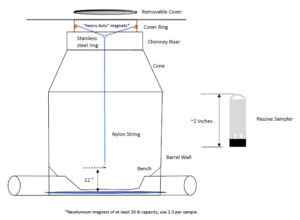
As illustrated in graphics from the guidance, deploy samplers using Sewer Cleanout Caps designed to securely hold samplers within existing cleanouts, or in manhole shafts using a magnetic suspension system.

Q: How is passive sampling different from grab sampling?
A: Passive data are integrated over time instead of a single point-in-time measurement, using sorbent-based samplers without pumps, regulators, or power.
Q: What compounds can be detected?
A: VOCs and SVOCs including chlorinated solvents, petroleum hydrocarbons, and other volatile chemicals.
Q: Where can samplers be deployed?
A: Sewer lines, through manholes, cleanouts, drains, and other underground conduits
Q: How long are samplers deployed?
A: Typically from several days to multiple weeks depending on project objectives.
Beacon Passive Sampler Reporting Limits
(Click on the thumbnail to download)